
Refining Best Practices in Pediatric Atopic Dermatitis Treatment
Expert Perspectives
By Lyn Brook
Published
i3 Health recently provided an educational activity that challenged clinicians’ knowledge proficiency regarding atopic dermatitis in children and adolescents.
Gaps and Challenges
Atopic dermatitis is a chronic, relapsing, inflammatory condition that affects the skin and other organ systems and is pathologically characterized by skin barrier dysfunction, inflammation, and chronic pruritus. It affects up to 20% children in the United States. Atopic dermatitis disproportionately affects people of color: Black children are at sixfold greater risk for severe atopic dermatitis compared with White children. Children with atopic dermatitis experience a high symptom burden, including pruritus, pain, and sleep disturbances, which significantly impact quality of life. These effects highlight the importance of understanding disease severity and impact from the patient’s perspective; they also underscore the need to ensure that disease management is tailored to the individual patient. Due to the challenges in treating pediatric atopic dermatitis, it is imperative that members of the multidisciplinary care team receive up-to-date educational opportunities on this topic.
Addressing the Gaps
To address the knowledge gaps experienced by clinicians regarding atopic dermatitis, i3 Health curated the CME/NCPD/AAPA-accredited enduring activity titled, Best Practices and Emerging Evidence in the Treatment of Atopic Dermatitis in Children and Adolescents. The activity was made available on i3 Health’s website beginning December 20, 2024, until December 19, 2025. Leading the activity were two key speakers in the field of atopic dermatitis, Peter A. Lio, MD, a Clinical Assistant Professor of Dermatology & Pediatrics at Northwestern University, Feinberg School of Medicine; and Linda F. Stein Gold, MD, the Director of Dermatology Clinical Research and the Division Head of Dermatology at Henry Ford Health.
A total of 2,867 learners participated in the activity, with 433 completing it for credit. Most learners were nurses, followed by physician assistants, nurse practitioners, primary care physicians, other specialty physicians, dermatologists, and those who chose “other” as their profession.
The baseline data collected revealed knowledge gaps in the following areas:
Appraising clinical features that can inform the differential diagnosis of atopic dermatitis in children and adolescents
Evaluating the efficacy and safety of novel and emerging therapies for atopic dermatitis in children and adolescents
Efficacy of the Education
Participants were given a matching pretest and posttest at the beginning and end of the activity, respectively:
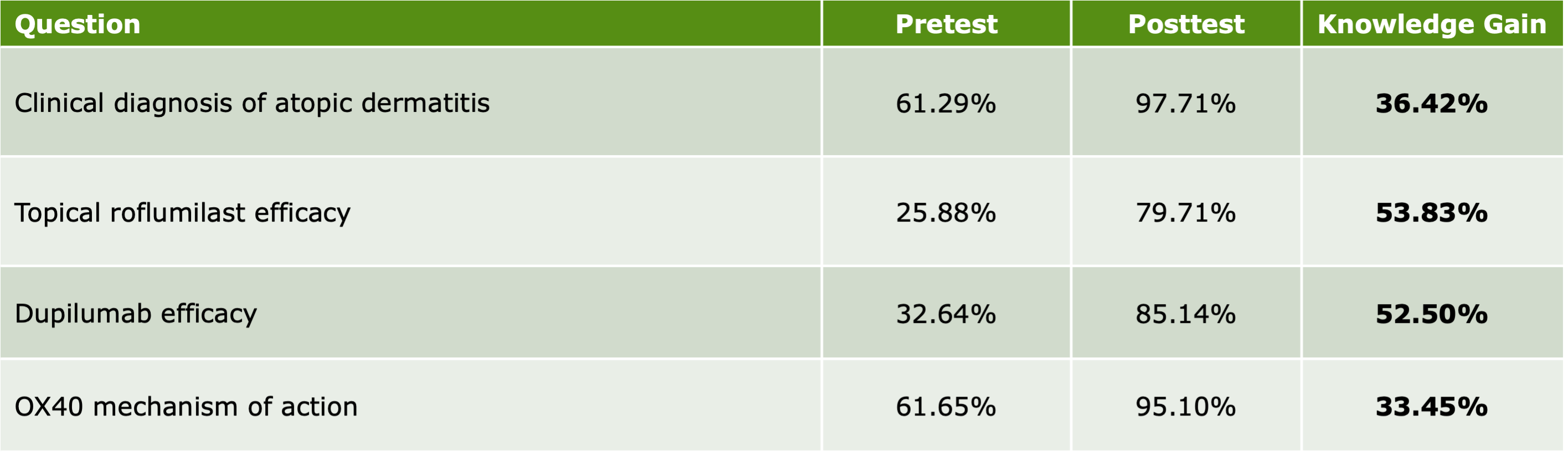
Upon completion of the activity, 87% of learners who completed the evaluation (N=433) reported that they felt more confident in managing patients with atopic dermatitis, and 85% felt the material presented would be used to improve the outcomes of their patients.
Future Education
The data revealed by the posttest assessment affirm the effectiveness of online educational content pertaining to the topic of atopic dermatitis. Based on these data, i3 Health has determined that clinicians may benefit from CME/NCPD/AAPA activities that provide education on:
Appraising clinical features that can inform the differential diagnosis of atopic dermatitis in children and adolescents
Evaluating the efficacy and safety of novel and emerging therapies for atopic dermatitis in children and adolescents
Resources
i3 Health (2026). Best practices and emerging evidence in the treatment of atopic dermatitis in children and adolescents: activity outcomes report. Data on file.